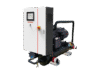
Ochsner High-Temperature Heat Pumps

The Ochsner IWWHS high-temperature series enables heat generation with a supply temperature of up to 95 °C. It offers an efficient and high-performance solution for industrial and commercial applications as well as for district heating. Its robust design, featuring screw compressors, ensures high reliability and durability.

Application
Multi-family houses, commercial and industrial, public buildings, new construction, renovation
Installation
Indoor installation
Operating range
60 kW - 530 kW

Pro­duct de­tails

The advantages of the Ochsner heat pump at a glance:


  • Synthetic refrigerant
  • Safety refrigerant R1233zd
  • High efficiency
  • Supply temperature up to 95 °C
  • Ochsner Megatronic SPS machine control
  • Robust construction with tube bundle heat exchangers

Cli­ma­te pre­mi­um

Are you replacing a fossil gas or oil heating system with a renewable heating system? Benefit from attractive subsidies.

References

    Do you have any ques­ti­ons?

    Benefit from our many years of experience and let our specialists advise you individually, without obligation and free of charge.

    Fre­quent­ly as­ked ques­ti­ons?

    The heat pump extracts thermal energy from the ambient air. The refrigerant absorbs this heat in the heat exchanger (evaporator) and is then compressed in the compressor. The heat generated in this process is used for heating and hot water production via another heat exchanger. In summer, the cycle can also be used for cooling by reversing the process.

    The heat pump extracts thermal energy from the ground using a geothermal probe or groundwater. The refrigerant absorbs this heat in the heat exchanger (evaporator) and is then compressed in the compressor. The heat generated in this process is used for heating and hot water production via another heat exchanger. In summer, the cycle can also be used for cooling by reversing the process.

    Heat pumps are suitable for both and can therefore be used in new buildings and old buildings undergoing renovation. With the latest generation of heat pumps, flow temperatures of up to 70° can be achieved.
    However, it may be worth replacing or adding new radiators with a larger heating surface area in order to increase the efficiency of the heat pump. Seek advice from a specialist. In general, energy-saving measures should be considered for the building envelope in order to directly reduce the heat demand and thus reduce the flow temperatures and increase the efficiency of the heat pump.

    Yes, because all our heat pump systems are designed for the design temperature. However, there are some differences between the various heat pump systems that need to be taken into account:

    Air/water heat pumps:
    Air/water heat pumps have a lower operating limit (approx. -25°C). For heating systems, this means that the heat output is guaranteed up to the design temperature (in the Swiss Plateau, for example, at -7°C). If the outside temperature falls below this design temperature, the auxiliary heating can switch on automatically. Statistically speaking, however, this is extremely rare.

    Brine/water heat pumps:
    With brine/water heat pumps, it is important to dimension the geothermal probes correctly. The geothermal energy at depth is constant and changes only minimally, even if the top layer of soil is frozen.

    A heat pump with a COP of 5 requires 1/5 of the total energy produced in the form of electrical energy, while 4/5 of the energy is obtained from the environment (ambient air, geothermal probe, etc.).
    The COP is highly dependent on the source temperature and the flow temperature. The higher the source temperature and the lower the flow temperature, the higher the COP and the energy efficiency.
    In combination with a PV system, the amount of electricity consumed can be increased and energy costs reduced.

    The sound insulation of heat pumps can be improved through structural measures. The most important measure is to physically decouple the heat pump from the house. Pipes must also be physically decoupled using suitable mounting systems. Sound insulation hoods or sound insulation walls can also significantly reduce noise levels.

    Heat pumps are generally very low-maintenance. However, a heat pump should not be neglected. Contamination on the outdoor unit or in the heating circuit, incorrect settings, incorrect heating curves, etc. can damage the heat pump or reduce its efficiency. Periodic maintenance is therefore always beneficial and extends the service life.

    The cost of a heat pump varies depending on the type and size of the system. An air/water heat pump for a single-family home of approximately 150 m² typically costs between CHF 30,000 and CHF 40,000, while a ground-source heat pump (geothermal energy) often costs between CHF 40,000 and CHF 50,000. Installation and additional work such as drilling or connection costs have a significant impact on the price.

    Yes, both the federal government and the cantons offer subsidy programs to support the installation of heat pumps. The amount of the subsidy depends on the canton and the type of heat pump. There are often tax advantages in the form of deductions that can currently still be claimed. However, with the rejection of the owner-occupied housing allowance, this is expected to fall in 2028. Our sales advisors will be happy to provide you with more information.

    Heat pumps have low operating costs compared to fossil fuels such as oil and gas. Operating costs are heavily dependent on energy costs, but correct hydraulic integration and correct operation also have an influence. In Switzerland, heat pumps are generally inexpensive to operate.

    Heat pumps offer many advantages:

    • Environmentally friendly: They use renewable energy sources (air, earth, water).
    • Energy efficient: High efficiency compared to traditional heating systems.
    • Low operating and maintenance costs: Significantly lower than fossil fuel heating systems.
    • Long service life: Heat pumps have a service life of 15–20 years.

    As a rule, replacement is possible. However, both the building envelope and the existing heating system must be taken into account. In very old buildings or those with poor insulation, it is advisable to first renovate the building envelope and then modernize the heating system.

    The approval process varies from canton to canton. For many air/water heat pumps within the building zone, a notification procedure with the municipality is now sufficient, whereby the most important documents, including noise protection certification, must be submitted. In special cases (core zones, listed buildings, groundwater protection areas, or geothermal heat pumps), a building permit is required and, depending on the case, a cantonal drilling permit may also be necessary. Our sales staff will be happy to assist you with this.

    Heat pumps are considered virtually carbon neutral, especially when the electricity comes from renewable sources. Compared to oil or gas heating systems, CO₂ emissions can be reduced by up to 95%.

    Financially and ecologically, the switch is definitely worthwhile in the long term. The investment pays for itself over the years thanks to lower operating costs and subsidies. In addition, the value of the property increases when it is renovated with efficient technology. As fossil fuel heating systems will be gradually banned in the future, the switch is also a future-proof decision.

    Yes, air/water heat pumps require a noise protection certificate, which must be issued by a specialist. This ensures that the legal noise limit values specified in the Noise Abatement Ordinance are complied with.

    OCHSNER IWWHS High-Temperature Heat Pumps

    Functions of Large-Scale Heat Pumps

    OCHSNER large-scale heat pumps have a wide range of applications. They are used in larger buildings and perform a variety of functions:

    • Heating
    • Air conditioning
    • Hot water supply

    In industrial applications, process heat up to 95 °C can be provided. In district heating networks, OCHSNER large-scale heat pumps installed in the system raise the temperature level and increase efficiency.

    Industrial heat pumps: Areas of application

    OCHSNER industrial heat pumps are characterized by a wide variety of applications:

    • Apartment buildings
    • Hotels and restaurants
    • Hospitals
    • Care homes and educational institutions
    • Office and commercial buildings
    • Industry
    • District heating networks

    A wide variety of heat sources can be utilized

    In addition to the common heat sources—air, ground, or groundwater—OCHSNER large-scale heat pumps are capable of utilizing a wide variety of other heat sources. In industry or data centers, process heat or waste heat from computers—which is often vented and wasted today—can be recovered. Usable heat is also extracted from the kitchen or wellness areas of large hotels. When used in municipal infrastructure, the sewer system plays an important role as a heat source through waste heat from wastewater.

    Heating in industry: economically and ecologically sensible

    For many companies, environmental and climate protection are high on the agenda alongside economic efficiency. OCHSNER large-scale heat pumps can make a significant contribution to tangible improvements in both areas:

    • Thanks to their high performance and efficiency, industrial heat pumps can reduce energy costs.
    • At the same time, OCHSNER large-scale heat pumps significantly minimize CO2 emissions.

    Machine Control and Peripheral MSRL Functions

    The electronic MEGATRONIC controls in OCHSNER large-scale heat pumps represent the state of the art. They regulate and perform monitoring of the heat pump and record all relevant values in real time. Peripheral control enables the operation of circulator pumps and valves, buffer management, or circuit configurations for heating as well as active and passive cooling. Clear displays and logging of values provide the operator with valuable information. Integration into building management systems is provided, as is remote monitoring via LAN or the Internet.


    This site is registered on wpml.org as a development site. Switch to a production site key to remove this banner.